The application of alumina ceramics (mainly
99% alumina or higher purity) in seawater desalination energy recovery systems primarily refers to their role as durable materials in the core component, the "pressure exchanger" (PX).
Alumina ceramic energy recovery devices are core components for achieving high-efficiency energy recovery in the seawater desalination industry. Their key moving parts are made of high-purity alumina ceramic, significantly improving the reliability and lifespan of the equipment under high-salt and high-pressure environments. This device uses the principle of positive displacement to directly transfer the energy of the high-pressure concentrated brine generated during reverse osmosis to the low-pressure feed water, achieving an energy recovery efficiency of 95%–98%.
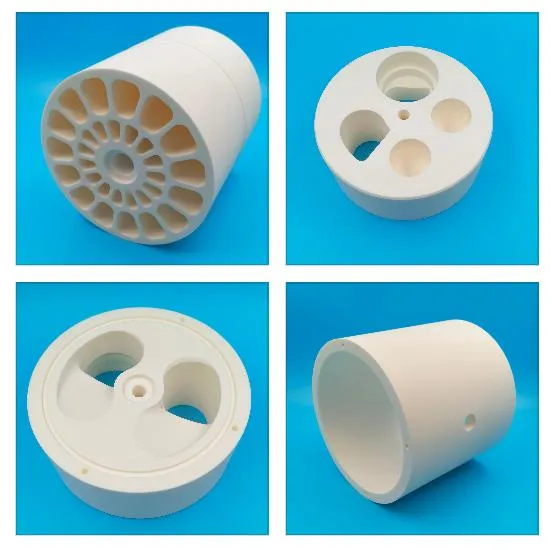
99% Alumina Ceramic PX Energy Recovery Devices
It is not used for power generation, but rather utilizes its superior corrosion resistance and wear resistance to efficiently recover the pressure energy of concentrated brine under extremely high pressure, thereby reducing the energy consumption of seawater desalination by nearly 60%.
Core Advantages of Alumina Ceramic PX Energy Recovery Devices
The use of alumina ceramic solves the fatal flaw of traditional metal components that cannot operate stably for long periods under high-pressure seawater environments:
1. Extreme Corrosion Resistance: Alumina ceramic has extremely high chemical inertness, completely resisting the long-term corrosion of high-concentration chloride ions (Cl⁻) in seawater. This is the main reason why metal materials (such as stainless steel) will experience pitting or crevice corrosion within a few years.
2. Ultra-high wear resistance: The extremely high hardness of the ceramic allows it to withstand the erosion of tiny solid particles (such as silt) in high-pressure seawater, as well as the friction of the rotor rotating at thousands of revolutions per minute. Data shows that its annual wear is less than 3 micrometers, meaning that the total wear over 25 years of continuous operation is only about 0.076 millimeters.
3. Self-lubricating properties: Alumina ceramics possess natural "hydrodynamic bearing" properties in seawater environments. When the rotor rotates at high speed, a very thin film of seawater supports it, achieving operation without solid contact and fundamentally eliminating mechanical wear. This is the core secret to its extremely long lifespan.
4. Extremely low maintenance costs: Due to the material's superior durability, PX equipment has a design life of up to 30 years and requires no regular maintenance (such as oil changes or seal replacements). In large-scale seawater desalination plants, the operational reliability of PX equipment reaches 99.8%.
Specific Application Forms
1. Rotary Pressure Exchanger: Its core is a shaftless ceramic rotor with multiple longitudinal grooves on its surface. High-pressure concentrated brine drives the rotor to rotate, directly transmitting pressure energy through a "liquid piston" mechanism.
-
Key components: The ceramic rotor, distribution plate, and end caps are all made of high-purity alumina ceramic (99% Al₂O₃).
-
Energy recovery efficiency: Up to 98%, generally between 90% and 97%.
-
Application scale: Single unit flow rate can exceed 1000 m³/d, widely used in large-scale SWRO systems.
2. Piston-type valve-controlled pressure exchanger
-
Utilizes a dual-cylinder piston structure, with PLC-controlled directional valves for alternating operation. The ceramic valve core and sealing components are made of alumina ceramic, ensuring low leakage rates even under high pressure differentials.
-
Energy recovery efficiency: >92%
Industry case study
-
Veolia Australia desalination plant: Recovers up to 97% of energy from concentrated brine using a pressure exchanger, significantly reducing energy consumption. Key pressure-resistant and wear-resistant components extensively utilize advanced ceramic materials.
-
Caribbean BOO Projects: Nine desalination plants built between 1990 and 2000 housed 17 high-capacity power exchangers, all relying on ceramic components for long-term stable operation.
-
Abu Dhabi's Tawil 900,000-ton-per-day desalination plant: Operating in a high-temperature, high-salinity environment, the key energy recovery unit utilizes alumina ceramic rotors to ensure efficient and continuous system operation.
Alumina ceramics are the unsung heroes supporting the efficient and low-cost operation of modern seawater desalination. Their inherent chemical inertness and mechanical hardness allow them to successfully recover previously wasted high-pressure energy, converting it into economic benefits.


 +86 181 0845 7259
 marketing@guociceramic.com
 English
 Español
 Deutsch
 اللغة العربية
 Русский язык