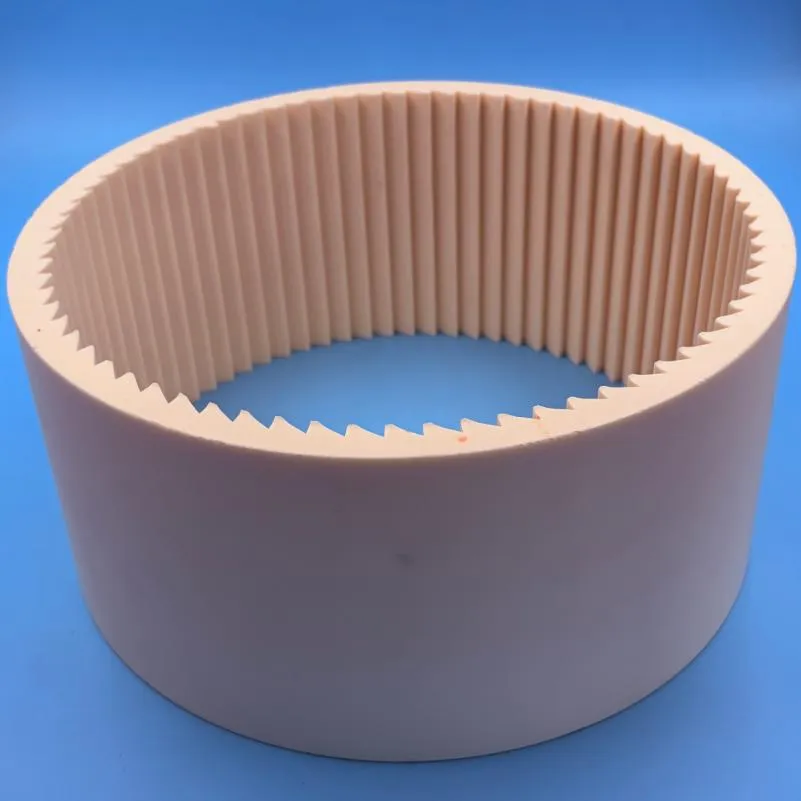
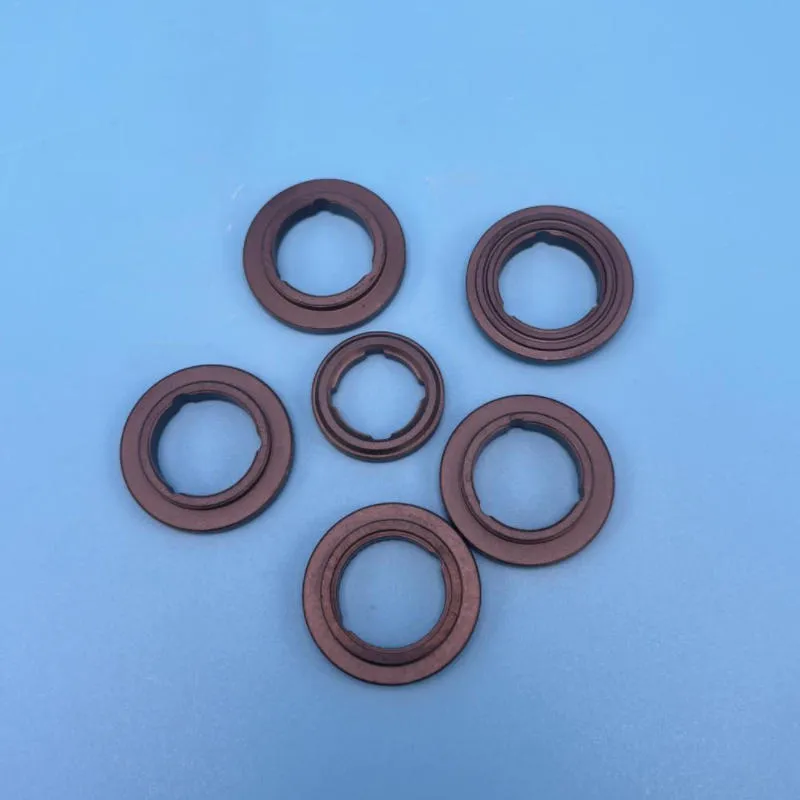
Although visually similar to common industrial nylon internal gear coupling sleeves, the use of alumina ceramic (offering high-temperature resistance, strong corrosion resistance, and electrical insulation) shifts its primary application focus to the following specialized fields:
1. Corrosion-resistant and metal-contamination-free transport in the chemical and lithium battery industries
This is one of the most typical application scenarios for alumina ceramic internal gear rings.
-
Operating Conditions: In pumps transporting highly corrosive fluids (such as strong acids or alkalis) or in transport systems for lithium-ion battery cathode and anode materials, contamination of the medium by metal debris or dust is strictly prohibited.
-
Function: Serves as an internal gear or internal gear ring for corrosion-resistant or precision metering pumps. Ceramic materials are impervious to acid and alkali corrosion and possess extreme hardness, preventing wear-induced particle shedding and ensuring fluid purity.
2. Insulated Power Transmission for Semiconductor and High-Purity Vacuum Equipment
-
Operating Conditions: High-precision devices—such as semiconductor wafer manufacturing equipment and vacuum coating systems—often operate in high-temperature, ultra-clean environments and require superior electrical insulation.
-
Function: Serves as an insulating gear transmission sleeve. Leveraging the ceramic's excellent insulation, vacuum compatibility, and high-temperature resistance, it transmits torque while electrically isolating components to block static electricity or high-voltage currents and prevent arcing.
3. Transmission Support in High-Frequency Electromagnetic/Microwave Equipment
-
Operating Conditions: In high-frequency electromagnetic environments—such as microwave heating systems, radar communication equipment, and high-frequency induction furnaces—standard metal components can overheat or even melt.
-
Function: Serves as a wave-transparent transmission shaft sleeve or gear. Alumina ceramics offer excellent dielectric properties and a low loss tangent, allowing microwaves or high-frequency beams to pass through without loss; this makes them ideal for mechanical transmission within high-frequency energy fields.
4. Couplings for High-Temperature or Vacuum Environments
-
Operating Conditions: Couplings made of standard rubber or nylon soften, deform, or outgas at temperatures exceeding 150°C, leading to failure.
-
Function: Serves as the internal gear sleeve for high-temperature-resistant couplings. Ceramics maintain exceptional mechanical strength and dimensional stability at temperatures reaching several hundred degrees Celsius, serving as a perfect replacement for nylon or metal couplings to ensure precision transmission with zero deformation and zero outgassing.



 +86 181 0845 7259
 marketing@guociceramic.com
 English
 Español
 Deutsch
 اللغة العربية
 Русский язык