Ceramic Tubes

Hunan Guoci New Material Technology Co., Ltd.

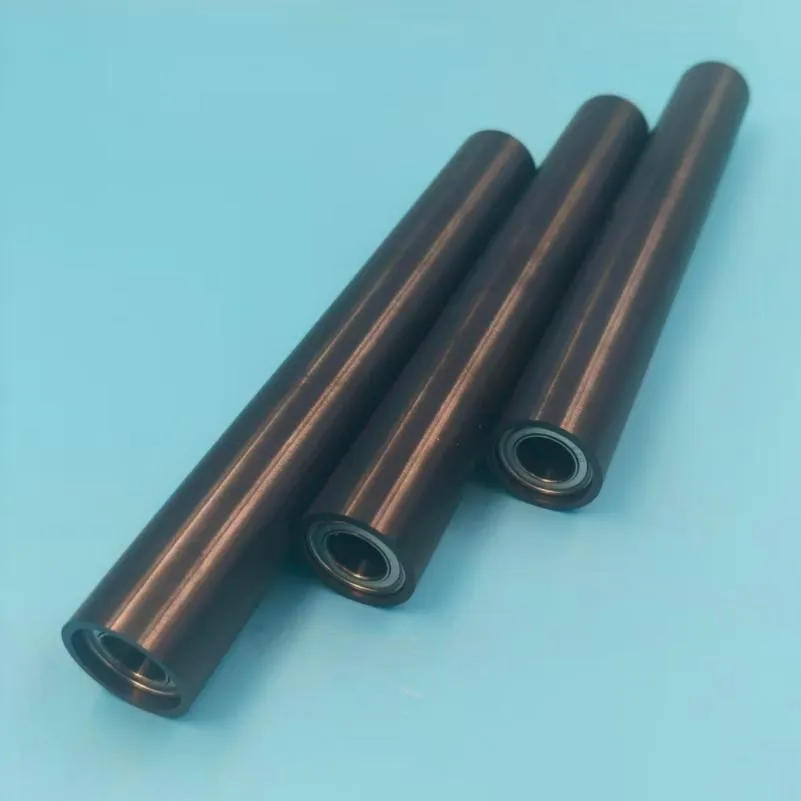
Zirconia Ceramic Parts,Ceramic to Metal Parts
Zirconia Ceramic Rollers Custom anti-static metal-ceramic rollers for lithium battery winding machines

Zirconia Ceramic Rollers Custom Ceramic-to-Metal Antistatic Rollers for Lithium Battery Winding Machines


Material: Zirconium Oxide, Zirconia, ZrO2

Sizes:Min-OD: 0.02mm; Max-length: 500mm

Features:High fracture toughness, Excellent wear resistance, Low coefficient of friction, Excellent biocompatibility.

Customized: Can be custom for special sizes and shapes

Delivery Times:2 -25 days(depends on the structure and quantity)

  1. Fracture Toughness (MPa·m¹/²): 6 - 12
  2. Refractoriness: 1000℃
  3. Density: 5.9-6.0 g/cm3
  4. Flexural Strength (MPa): 800-1300
  5. Thermal Conductivity: 2.5W/M.K
Transport Package: Cartons

Shipment: by sea by air by courier by post etc.

    Welcome to leave us a message

  • Close

Product Description

Zirconia ceramic antistatic rollers are functional ceramic components designed specifically for high-cleanliness, high-precision industrial environments. With their excellent static dissipation capabilities and mechanical properties, they have become a core component in lithium battery winding machines, ensuring high production yields. While maintaining the high strength and wear resistance of zirconia ceramics, they achieve stable conductivity through material modification, effectively addressing the problem of electrostatic adsorption on electrode sheets.

These ceramic rollers are typically manufactured using isostatic pressing, high-temperature sintering, and precision grinding processes to ensure high dimensional accuracy and a smooth surface finish (Ra ≤ 0.2 μm), meeting the stringent requirements of stable operation and cleanliness in automated lithium battery production lines. These rollers combine the high hardness, wear resistance, and antistatic properties of zirconia ceramics, making them suitable for automated lithium battery production lines with high cleanliness requirements.

Core Performance Advantages

Zirconia ceramic antistatic rollers combine the mechanical advantages of structural ceramics with the functional characteristics of antistatic materials, primarily in the following aspects:


1. Excellent Antistatic Capability

  • Zirconia ceramic (ZrO₂) is an insulator at room temperature with a resistivity greater than 10¹⁰ Ω•cm. However, its conductivity increases significantly with increasing temperature. At 1000℃, the resistivity drops to 10⁴Ω•cm, while at 1700℃, the resistivity is only 6~7Ω•cm.
  • This effectively prevents the electrode from attracting environmental dust due to electrostatic discharge during high-speed operation, reducing the risk of foreign matter introduction and improving battery safety.

2. High Hardness and Wear Resistance
  • Zirconia ceramic itself has a Mohs hardness of 9 and a three-point bending strength of 1000–1175 MPa, far exceeding that of ordinary ceramics and metals.
  • Under continuous high-speed friction conditions (such as winding machine linear speed > 1 m/s), the roller surface is not easily worn or scratched, ensuring long-term stable operation.

3. Strong Chemical Stability and Corrosion Resistance
  • It is insoluble in most acid and alkali solutions (except hydrofluoric acid), resistant to organic solvent corrosion, and adaptable to solvent environments such as NMP (N-methylpyrrolidone) that may exist in lithium battery workshops.

4. High Bending Strength and Toughness
  • Three-point bending strength reaches 600–1,175 MPa, and fracture toughness is approximately 7–8 MPa·m¹/², making it one of the toughest ceramic materials and capable of withstanding certain impact loads.

5. No Metal Contamination, High Cleanliness
  • The all-ceramic structure avoids rust or flaking particles that may occur with metal rollers, meeting the stringent requirements of lithium batteries for magnetic impurities <25 ppb.

6. Good Thermal Stability
  • It can operate stably for extended periods below 400℃, adapting to temperature variations in pre- and post-processing conditions such as drying and hot pressing.

7. High Surface Finish
  • It can be processed to a mirror finish, posing no risk of scratching materials requiring precision contact (such as lithium battery electrodes and optical films).

Specific Application Areas

Antistatic zirconia ceramic rollers are mainly used in automated equipment requiring static sensitivity, high wear resistance, and clean environments:


Applications Specific Uses Core Values
Lithium Battery Manufacturing Winding machine guide rollers, electrode pressing rollers, crusher rollers. Prevents electrostatic discharge (ESD) from damaging the separator; high hardness ensures uniform electrode thickness and extends equipment life.
Semiconductor/Electronics Manufacturing Wafer Transfer Rollers, PCB Guide Rollers, Adsorption Nozzles, Inspection Tweezers Prevents ESD damage to precision electronic components; clean and dust-free environment.
Photovoltaic/Solar Energy Cell Coating Transfer Rollers, Silicon Wafer Grinding Rollers High surface finish prevents scratches; wear resistance ensures stable operation over long periods.
Powder Metallurgy/New Materials Nanomaterial Crushing and Classifiers, High-Purity Material Conveying Rollers No metal contamination, ensuring material purity.
Food/Pharmaceutical Cleanroom Conveying Rollers, Packaging Equipment Guide Rollers Antistatic, prevents dust adsorption; corrosion resistant and easy to clean.
Welding Equipment High-Frequency Welding Support Rollers, Welding Wire Conveying Rollers Non-magnetic and non-conductive, avoiding electromagnetic interference during welding.