In modern industry, especially under extreme conditions of high pressure, high corrosion, and high wear, the performance limitations of traditional metal components are becoming increasingly apparent. In high-precision industrial applications such as oil extraction, chemical production, and pharmaceutical manufacturing, pumps, as core devices for liquid transport and pressure regulation, rely heavily on the performance of their core component—the plunger—which directly determines the equipment's lifespan and production efficiency. Metal plungers, due to their poor wear resistance, susceptibility to corrosion, insufficient high-temperature stability, and high maintenance costs, struggle to meet the industrial demands for high precision, long lifespan, and resistance to extreme working conditions. A solution centered on advanced ceramic materials has emerged and rapidly become the core of key equipment upgrades—the
ceramic plunger.
These precision components, made from high-performance ceramic materials such as alumina and zirconia, are reshaping the technical standards of industrial pumps thanks to their high hardness and wear resistance (lifespan more than 10 times that of metals), chemical inertness and corrosion resistance, high-temperature resistance, and dimensional stability. Combined with cost reductions due to advancements in manufacturing technology, they provide a solid guarantee for the stable and efficient operation of various equipment.
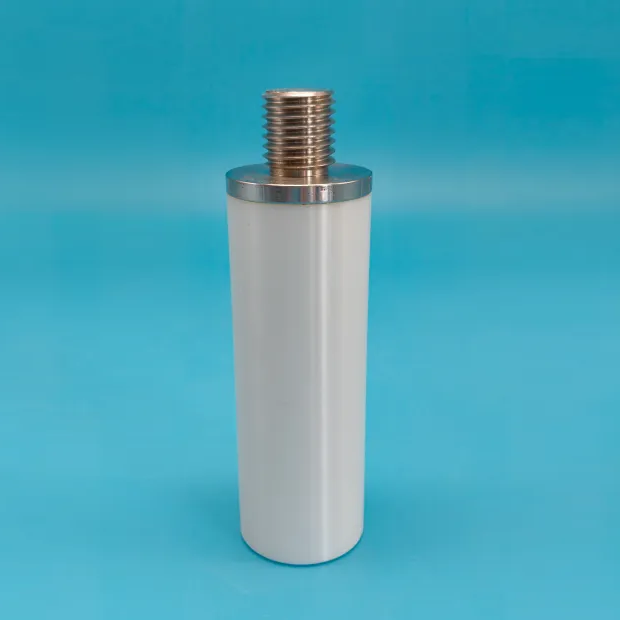
1. What is a Ceramic Plunger?
A ceramic plunger is a cylindrical precision moving component made from high-performance engineering ceramic materials. It is typically used as a core moving part in high-pressure pumps, metering pumps, spray equipment, and ultra-high-pressure cleaners, performing high-speed reciprocating motion within the cylinder to transport, pressurize, or meter various fluids (including water, oil, chemical media, slurries, etc.).
It is not "ceramics" in the traditional sense, but a high-tech product manufactured through precision engineering design and advanced processes (such as isostatic pressing, high-temperature sintering, and precision machining with diamond grinding machines). It is an outstanding representative of materials science in industrial applications.
Its core characteristics are:
① Ultra-high hardness (e.g., zirconia hardness ≥ 9 Mohs, close to diamond)
② Corrosion resistance (resistant to strong acids, strong alkalis, and organic solvents)
③ Low coefficient of friction (e.g., silicon nitride has excellent self-lubricating properties)
④ Long service life (wear resistance is 5-10 times that of metal plungers)
The manufacturing process of ceramic plungers integrates materials science and precision machining technology: taking zirconia ceramic plungers as an example, the raw material needs to be sintered at a high temperature of 1500-1700℃ to form a dense crystalline structure, and then the core roundness error is ≤0.005mm and the surface finish reaches a mirror effect through diamond wheel grinding and laser polishing. This process endows ceramic plungers with physical properties surpassing those of metals—their hardness can reach HRA82-85, more than 30% higher than that of quenched steel (HRA60-65); in terms of corrosion resistance, the mass loss rate after immersion in 10% hydrochloric acid (25℃) for 30 days is <0.01%, while 316L stainless steel corrodes at a rate of 0.5mm/year under the same conditions.
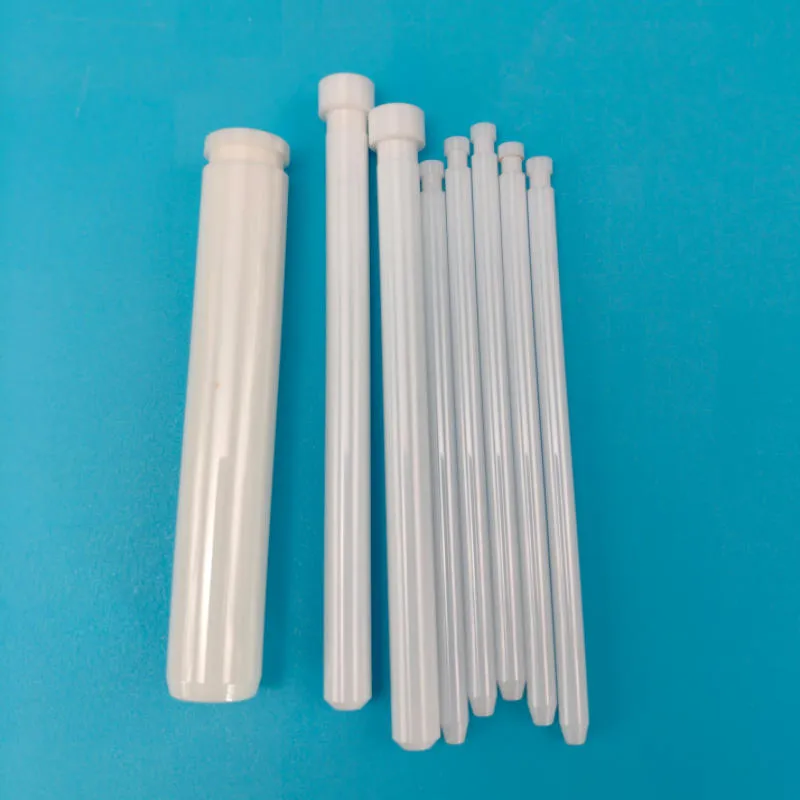
Zirconia Ceramic Plungers Manufactured by Guoci Ceramics
2. Why Choose Ceramic Plungers? — Five Irreplaceable Advantages
Compared to traditional metal (chromium steel, stainless steel) plungers, ceramic plungers offer revolutionary advantages:
Extreme Wear Resistance, Doubled Lifespan: The hardness of ceramics (HRA 85-90) is far higher than that of metals, providing extremely strong resistance to abrasive and adhesive wear. In practical applications, their lifespan can be 5-10 times longer than that of metal plungers, significantly reducing spare parts costs and downtime.
Excellent Corrosion Resistance, Unfazed: They possess perfect inertness to most acids, alkalis, salts, organic solvents, and other chemical media, and will never rust. Especially suitable for highly corrosive environments such as electroplating, PCB manufacturing, chemical processing, pharmaceuticals, and seawater desalination.
Smooth operation and durable sealing:
-
Low coefficient of friction: Low coefficient of friction with rubber or polyurethane seals results in smoother operation and reduced power consumption.
-
Dimensional stability: Low coefficient of thermal expansion ensures almost no deformation under temperature changes, maintaining a tight fit with seals for extended periods, effectively preventing internal leakage and maintaining high volumetric efficiency.
-
High rigidity and deformation resistance: High elastic modulus ensures almost no elastic deformation under ultra-high pressure, guaranteeing accuracy and stability during pressurization, crucial for precision metering and ultra-high pressure jets.
-
Clean and inert, meeting stringent standards: Surface finish can reach mirror level (Ra < 0.2μm), does not adsorb media, and is free from metal ion contamination, fully meeting the high purity requirements of industries such as food, pharmaceuticals, and semiconductors.
3. Common Materials and Advantages of Ceramic Plungers
Currently, the mainstream ceramic materials include alumina, zirconia, and silicon nitride. Due to differences in chemical composition and crystal structure, each is suitable for different operating conditions.
(1) Alumina Plunger:
-
Economical and practical: It has high hardness and wear resistance, excellent corrosion resistance, and a lower cost compared to zirconia.
-
Applicable scenarios: Suitable for medium and high pressure, general wear-resistant and corrosion-resistant working conditions, it is a cost-effective choice, such as general chemical pumps and sewage treatment pumps.
(2) Zirconia Plunger:
-
Performance king: It is currently the ceramic plunger material with the best comprehensive performance and the widest application. Its fracture toughness is 2-4 times that of alumina, with extremely high bending strength and wear resistance, while having a low coefficient of friction and a certain degree of self-lubrication.
-
Applicable scenarios: Applications with extremely high requirements for reliability, lifespan, and pressure resistance, such as ultra-high pressure cleaners (above 300-500 bar), high-end plunger pumps, and precision metering pumps.
(3) Silicon Nitride Plungers:
Silicon nitride materials, with their high hardness and toughness, excellent thermal stability, unique self-lubricating properties, and superior chemical inertness, have become the preferred solution for extreme working conditions. For example, silicon nitride plungers can be used in harsh environments such as molten metal conveying and chemical media processing. In applications such as continuous casting crystallizers and high-temperature molten salt pumps, their lifespan can be more than 10 times that of metal plungers. In lithium battery manufacturing, silicon nitride ceramic plunger pumps can accurately convey electrolytes containing solid particles, and their wear resistance increases the pump's lifespan by more than 10 times compared to metal pumps.
4. Main application directions
(1) Pharmaceutical and medical device industry: In the process of drug production, the requirements for hygiene standards and drug purity are almost stringent.
The good chemical stability and self-lubricating properties of ceramic plungers make them widely used in equipment such as drug delivery pumps. For example, in the production equipment of biological agents such as insulin, ceramic plungers do not chemically react with the drug solution, ensuring the quality and safety of the drug. Furthermore, their self-lubricating working surface ensures stable equipment operation, reduces maintenance frequency, and guarantees production continuity.
(2) Environmental Engineering: Environmental monitoring equipment and wastewater treatment equipment often need to cope with complex and highly corrosive media.
Ceramic plungers can be used in wastewater lift pumps, dosing pumps, and other equipment. Due to their corrosion resistance and wear resistance, they can work stably for a long time in harsh environments such as wastewater and chemical agents, ensuring efficient equipment operation, helping environmental engineering facilities to function stably, and improving wastewater treatment efficiency and environmental monitoring accuracy.
(3) Petroleum and Chemical Industry: Petroleum extraction and chemical production are mostly carried out in high-temperature, high-pressure, and highly corrosive environments.
Ceramic plungers can be used in chemical pumps, metering pumps, and water injection pumps in petroleum extraction. For example, in chemical processes that transport strong acids such as sulfuric acid and hydrochloric acid, or strong alkalis such as sodium hydroxide, ceramic plungers can resist media corrosion, maintain normal equipment operation, reduce production interruptions and safety hazards caused by plunger corrosion damage, and significantly improve production efficiency and equipment lifespan. (4) Electronics Industry: The electronics industry has extremely high requirements for the cleanliness of the production environment and the precision of products.
Ceramic plungers play a crucial role in processes such as electronic paste delivery and precise liquid distribution in chip manufacturing due to their high precision and low contamination characteristics. For example, in photoresist coating equipment for chip manufacturing, ceramic plungers can precisely control the amount of photoresist delivered, and their smooth surface makes them less prone to adsorbing impurities, ensuring the purity of the photoresist and improving the yield rate of chip manufacturing.


 +86 181 0845 7259
 marketing@guociceramic.com
 English
 Español
 Deutsch
 اللغة العربية
 Русский язык