Ceramic Injection Molding (CIM) is a near-net-shape forming technology that combines polymer injection molding with ceramic manufacturing processes. Compared to traditional ceramic forming methods (such as dry pressing, slip casting, and hot die casting), CIM has the following significant advantages:
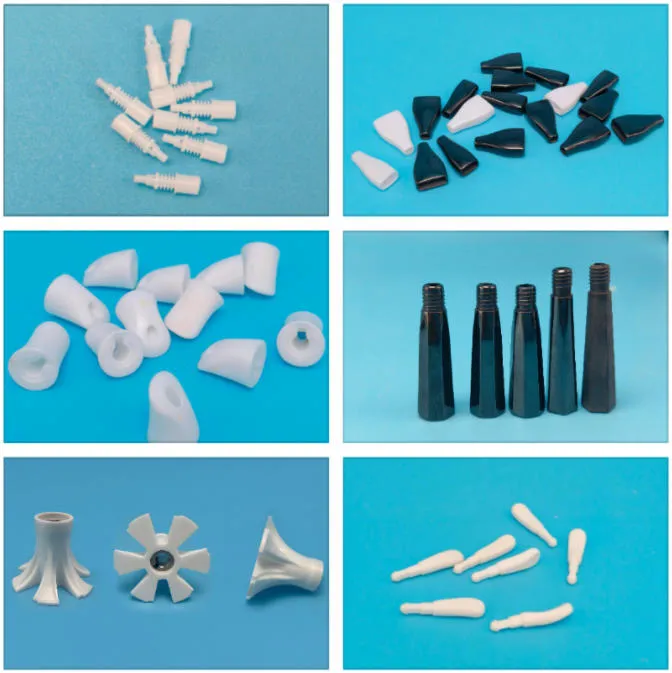
Ceramic injection molded parts manufactured by Hunan Guoci
1. Production Efficiency and Automation
-
High degree of mechanization and automation: The entire molding process can be precisely controlled by a program, facilitating production management and quality monitoring, and making it easy to achieve large-scale, mass production.
-
Short molding cycle and high production efficiency: Compared to traditional manual or semi-automatic slip casting and dry pressing processes, CIM significantly reduces the molding time per part, making it particularly suitable for large-volume orders.
-
Good product quality consistency: Due to the strong controllability of process parameters, performance fluctuations between products in the same batch are small, resulting in a high yield.
2. Shape Complexity and Precision
-
Capable of molding complex geometries: Traditional dry pressing is limited by unidirectional or bidirectional pressing, making it difficult to manufacture complex structures such as those with side holes, thin walls, and internal cavities; CIM, using metal molds for injection, is almost unrestricted by shape, allowing for the one-time molding of various complex-shaped small ceramic parts.
-
Near-net-shape forming, reduced post-processing: Sintered ceramic products require no or minimal machining, significantly reducing expensive ceramic machining costs (ceramic materials are hard, making machining difficult and costly).
-
Extremely high dimensional accuracy: The formed ceramic products have extremely high dimensional accuracy and surface finish, with a surface finish reaching 5μm.
3. Green body properties:
-
High green body strength: The injection-molded green body has uniform density and high strength, facilitating subsequent handling and debinding operations.
-
Excellent sintered body properties: Due to uniform feed mixing and high green body density, the final sintered ceramic parts exhibit superior mechanical properties and microstructure.
Summary of Comparison with Traditional Molding Methods
|
Comparison Dimensions
|
Traditional Molding (Dry Pressing/Slip Casting, etc.)
|
Ceramic Injection Molding (CIM)
|
|
Shape Complexity
|
Limited, suitable for simple shapes
|
Almost unrestricted, can mold complex structures
|
|
Dimensional Accuracy
|
Average
|
Extremely High
|
|
Surface Finish
|
Average
|
Up to 5μm
|
|
Production Efficiency
|
Low
|
High, suitable for mass production
|
|
Automation Level
|
Low
|
High
|
|
Post-Processing
|
High
|
Low or None
|
|
Product Consistency
|
Large Fluctuations
|
Good Consistency
|
Limitations to Note
CIM is not perfect. Its main shortcomings are:
-
High initial equipment investment and mold costs, making it suitable only for mass production to reduce costs.
-
The debinding process is complex and the most critical and problematic step in the entire process. Improper parameter control can lead to defects such as deformation and cracking.
-
The sintering shrinkage rate is relatively large (typically 13%–15%), requiring high precision control of sintering dimensions.
In summary, CIM's core advantage lies in its overwhelming efficiency and cost advantage compared to traditional molding methods in scenarios involving "
complex shapes + high precision + large batches." For products with simple shapes and small batches, traditional dry pressing and other methods remain more economical.


 +86 181 0845 7259
 marketing@guociceramic.com
 English
 Español
 Deutsch
 اللغة العربية
 Русский язык